Architectural Requirements
Section Brief
This section specifies the architectural decisions that govern UMTAS. Quality requirements are documented in Quality Requirements. Technology choices are documented in Technology Requirements.
1. Overall Software Architecture

2. Component Overview
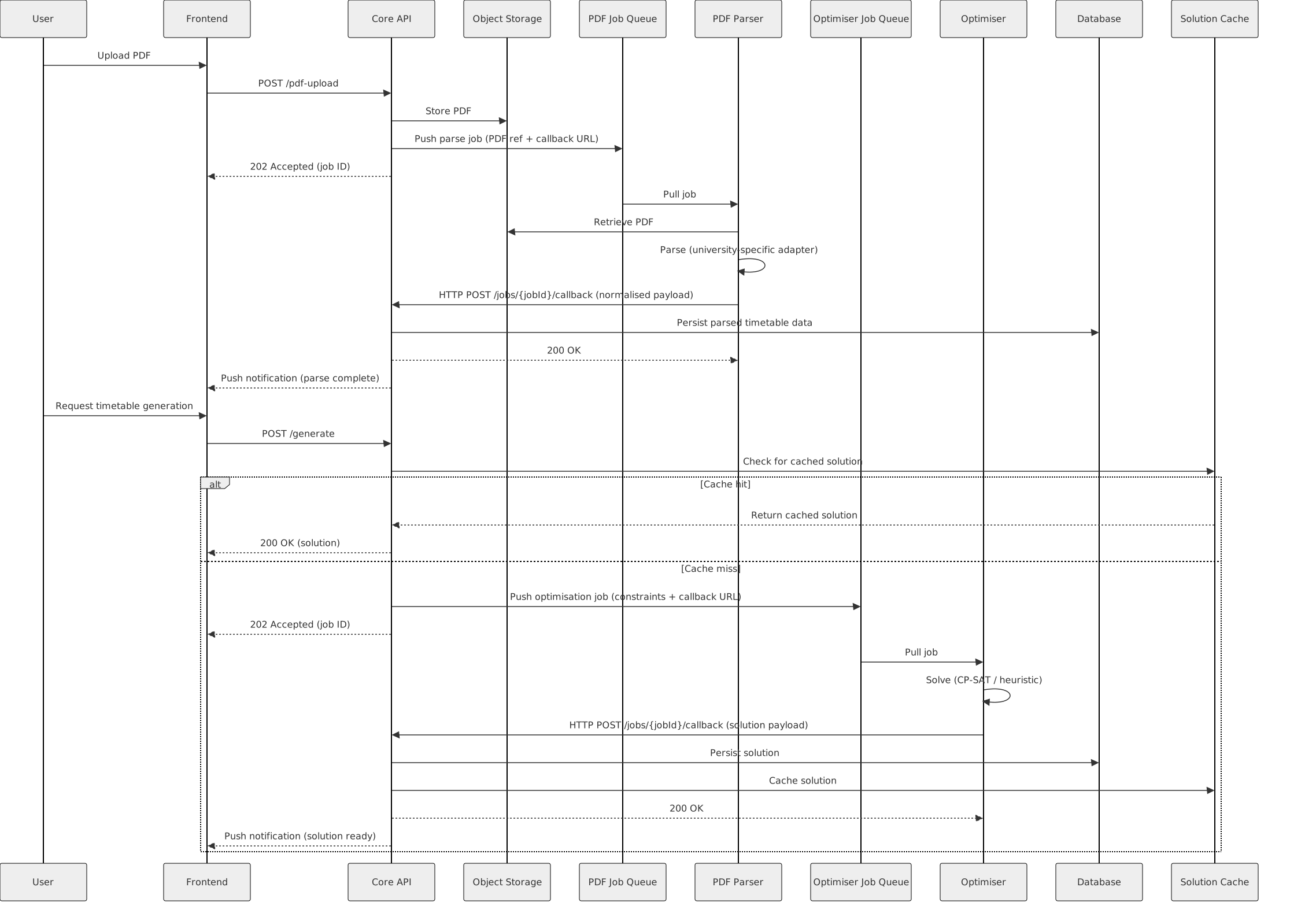
- Frontend - renders timetable views for all user roles. Handles authentication state and route-level access control. Communicates exclusively with the API Core via REST.
- API Core - single entry point for all client requests. Enforces JWT authentication (via BetterAuth) and RBAC. Owns all database access and orchestrates background job dispatch.
- Scheduling Optimizer - stateless computation service. Receives constraint specifications, executes scheduling algorithms, and returns solutions or partial results at timeout.
- PDF Parser - extracts and normalises timetable data from university-supplied PDFs. Runs as independently scalable workers consuming from the PDF job queue.
- University API Adapter - fetches and normalises structured data from external university APIs. Decoupled from the Core Engine via the adapter interface.
- PostgreSQL - system of record for all persistent data. Enforces referential integrity across modules, rooms, staff, and timetable slots.
- Redis - in-memory store for session tokens, solution cache, and BullMQ message brokering.
- BullMQ - decouples long-running tasks (optimisation, PDF parsing) from the synchronous request cycle. Provides retry, dead-letter, and job visibility.
3. Communication Patterns
- Request-Response (REST/HTTP) - all frontend → API and API → service calls.
- Push-Pull (BullMQ/Redis) - distributes parse and optimisation jobs across stateless worker replicas.
- HTTP Callback - workers notify the Core API of job completion via POST to a callback URL embedded in the job payload.
4. Architectural Patterns
- Client-Server - all frontends are thin clients. The server tier owns all state and computation.
- Service-Oriented Architecture (SOA) - solver and PDF parser are independently deployable compute services sharing the Core's data store.
5. Design Patterns
- Adapter - PDF Parser and University API Adapter normalise external data into the Core's format without modifying the Core Engine.
- Strategy - Scheduling Solver allows constraint programming and heuristic algorithms to be swapped without changing the surrounding service.
- Factory - resolves and instantiates the correct concrete adapter for a given university at runtime.
6. Architecture Constraints
| ID | Constraint | Source |
|---|---|---|
| C1 | The system must integrate with the Google Calendar API. The OAuth flow must conform to Google's OAuth 2.0 authorisation code flow with PKCE. | Client requirement |
| C2 | The constraint solver must expose its interface over HTTP, as it runs in a separate process and may be implemented in a different language from the primary server. | Language boundary - solver is Python |
| C3 | PDF parsing must support, at minimum, the University of Pretoria timetable PDF format at initial delivery. | Client requirement |
| C4 | All services must be containerisable and deployable on a standard Linux host via container orchestration. | Deployment environment |
| C5 | SSL termination and routing must be handled by a reverse proxy positioned in front of all backend services. | Security + deployment requirement |
| C6 | The system must be accessible via modern web browsers only. No native mobile application is required. Desktop and mobile viewports must both be supported. | Client requirement + end-user device |
| C7 | Monorepo tooling must support workspace-level dependency management across multiple applications (frontend, backend, solver). | Development environment |