Software Requirements Specification
Gesture-Based Drone Control System
1. Introduction
1.1 Purpose
This Software Requirements Specification (SRS) document describes the functional and non-functional requirements for the Gesture-Based Drone Control System (GBDCS). It is intended to guide the design, development, and testing of a system that enables users to control an unmanned aerial vehicle (UAV) through real-time hand gesture recognition, eliminating the need for traditional handheld remote controllers.
1.2 Scope
The Gesture-Based Drone Control System shall:
- Capture and interpret human gestures in real time using computer vision
- Translate recognized gestures into precise drone flight commands (e.g., takeoff, land, move, rotate, hover)
- Provide a low-latency, reliable communication interface between the gesture recognition module and the drone's flight controller
- Support operation in varied lighting and environmental conditions
- Ensure safe failsafe behavior in the event of gesture misrecognition or signal loss
The system is designed for applications including aerial photography, search and rescue operations, recreational use, and accessibility-focused UAV control for users with limited motor ability.
1.3 Definitions, Acronyms, and Abbreviations
| Term | Definition |
|---|---|
| UAV | Unmanned Aerial Vehicle — the drone being controlled |
| GBDCS | Gesture-Based Drone Control System |
| SRS | Software Requirements Specification |
| CV | Computer Vision — image processing used to detect gestures |
| ML | Machine Learning — used to classify gesture inputs |
| GCS | Ground Control Station — the processing unit running gesture recognition |
| API | Application Programming Interface |
| SDK | Software Development Kit |
| FPS | Frames Per Second — camera capture rate |
| Latency | Time delay between gesture input and drone response |
| Failsafe | Predefined safe behavior triggered upon system fault |
1.4 Overview
The remainder of this SRS is organized as follows:
- Section 2 — Functional Requirements: Details the specific behaviors and functions the system must perform.
- Section 3 — Non-Functional Requirements: Specifies performance, reliability, safety, and usability standards.
- Section 4 — Constraints and Assumptions: Lists technical, regulatory, and design limitations.
- Appendices: Supporting material including glossary, diagrams, and reference documents.
2. Functional Requirements
2.1 Gesture Recognition
- FR-01: The system shall capture video at minimum 30 fps
- FR-02: The system shall detect and track hand landmarks in real time using a computer vision library
- FR03: The system shall recognize a list of predefined gestures
- FR-04: The system shall reject unrecognized or ambiguous gestures and maintain the drone's last valid state.
2.2 Gesture Command Mapping
- FR-05: The system shall map each recognized gesture to a specific drone command
- FR-06: The system shall process and dispatch a command within 200ms of gesture recognition.
2.3 Drone Communications
- FR-07: The system shall trigger a failsafe hover or land command if the communication link is lost for more than 2 seconds.
- FR-08: The system shall receive and process telemetry data from the drone at regular intervals.
2.4 Failsafe and Safety
- FR-09: The system shall immediately command the drone to hover if no gesture is detected for more than 3 seconds.
- FR-10: The system shall initiate an emergency landing if the drone battery drops below 15%.
- FR-11: The system shall prevent takeoff if the gesture recognition module is not fully initialized.
- FR-12: The system shall log all issued commands and system events with timestamps for post-flight review.
2.5 User Interface
- FR-13: The system shall display a live camera feed with gesture landmark overlays on the operator's screen.
- FR-14: The system shall display the currently recognized gesture and the corresponding command in real time.
- FR-15: The system shall display key drone telemetry data including altitude, battery percentage, and flight mode.
- FR-16: The system shall provide visual and/or audio alerts for critical events such as low battery, signal loss, or failsafe activation.
3. Non-Functional Requirements
3.1 Performance
- NFR-01: End-to-end gesture-to-command latency shall not exceed 200ms
- NFR-02: Gesture recognition shall not cause CPU usage to exceed 70% on the target hardware.
3.2 Reliability
- NFR-04: The system shall maintain a command success rate of at least 95% under normal operating conditions.
- NFR-05: False command rate due to background noise or environmental interference shall not exceed 1%.
3.3 Usability
- NFR-06: A new user shall complete basic flight operations after no more than 15 minutes of training.
- NFR-07: All critical information shall be visible in a single view without navigation.
- NFR-08: Error messages shall clearly describe the issue and suggest a corrective action.
3.4 Safety
- NFR-09: All failure modes shall result in a defined safe state - no failure shall cause uncontrolled drone behavior.
3.5 Maintainability
- NFR-14: The codebase shall follow a modular architecture separating gesture recognition, command mapping, and drone communication.
- NFR-15: Each module shall have a unit test suite with at least 80% code coverage.
Base Features
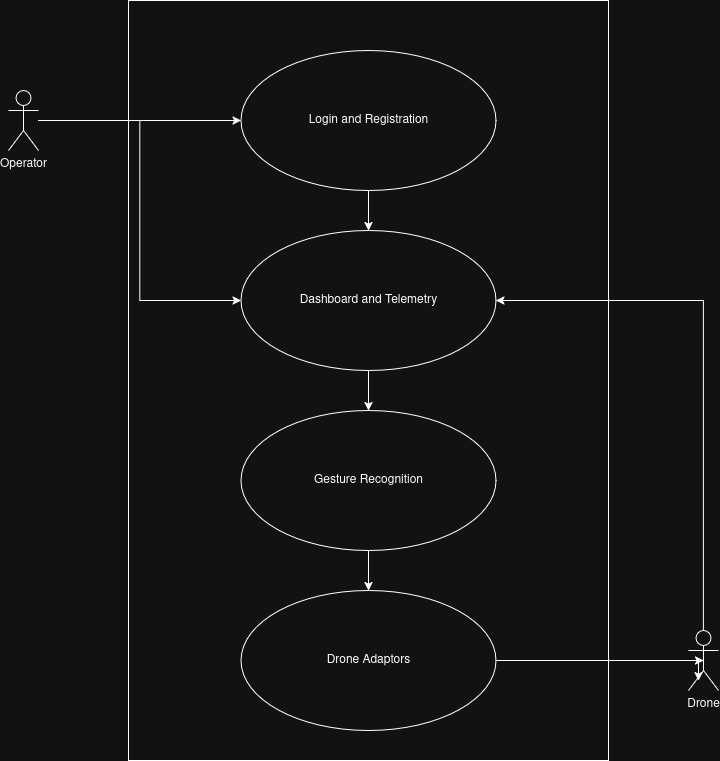
Some functionality is deemed as a base feature and as such does not fall part of a use case * Base Feature 1: Registration and Login System * Base Feature 2: Basic Themes * Base Feature 3: Form Validation
Use Cases
- Use Case 1: Hand Tracking and Gesture Recognition
- Use Case 2: Dashboard Telemetry
- Use Case 3: Drone Simulator and Adaptors
Use Case Diagram
Domain Model

Architecture Diagram
